





Richard Wolff, economist: "Trump is a symptom of the US empire's decline" - Diari de Barcelona

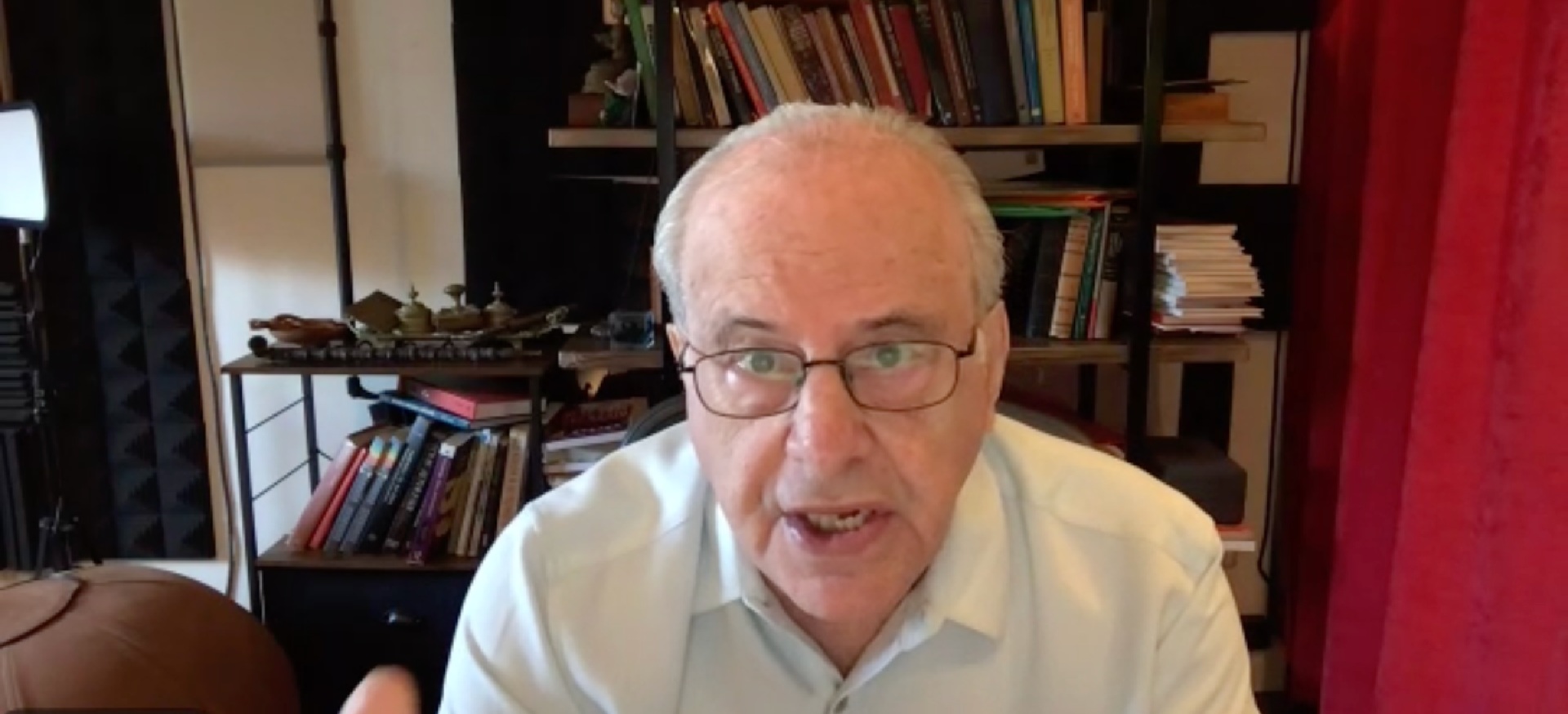
US LEADING SCHOLAR
Richard Wolff, economist: "Trump is a symptom of the US empire's decline"
Richard D. Wolff (Youngstown, 1942) is one of the most influential economists and critical intellectuals in the United States today. Professor Emeritus of Economics at the University of Massachusetts Amherst and currently a visiting professor at the New School in New York, his academic career, with training at Harvard, Stanford and Yale, has made him one of the most recognized voices in Marxist economics. In recent years, Wolff has also become a prominent media personality through his organization Democracy at Work and his popular weekly program Economic Update.
In this interview with Diari de Barcelona, Wolff breaks down with his signature clarity the origins of the American empire and its decline, how Trump is speeding it up, and recent developements in the US, such as the victory of the socialist and muslim Zohran Mamdani in the NY mayoral primaries.
Was Donald Trump a natural conclusion of the U.S. decline?
Yes, I think he is a symptom of a disease, the decline of an empire. And as you know, Spain too had its empire for a while. It is much more pleasant for people when the empire is developing and growing, and it is much less enjoyable when the empire is declining. And we have had a decline in the American empire pretty much since the early years of this century.
"The American empire has been declining since the early years of this century"
What do you mean by ‘the early years’?
2010 would be about right. But we must go back to the United States' position at the end of World War II as a very unusual situation in history to explain the current moment. Every other country that might have been a competitor of the United States was destroyed either by the Great Depression of the 1930s up until including World War II. Other than at Pearl Harbor at the beginning, no bombs fell in the United States. No civil war, no military activity in the United States throughout the war.
WWII helped them?
The war put the American economy into good shape. With Roosevelt as president, it took half of the unemployed millions and put them in the army, and the other half into work in the factories to produce guns, bullets and uniforms for the soldiers. You had a kind of military Keynesian economics, and it's very similar to what has happened in Russia during the Ukraine war. It took Russia from an economically difficult situation and actually improved it. The rest of Europe has been weakened by the Ukraine war, but Russia has not.
"Keyenesian military economics took Russia out of a financially difficult situation and improved it while the rest of Europe has been weakend by the war"
How did the empire start declining?
After World War II the US dollar displaced the British pound. The United States military set up a system of bases around the world and did more than 30 percent of the world trade. It was absolutely dominant, but everyone should have understood that this couldn't last, that the economies of Germany and Japan and the rest of Europe and Russia would return and become competitors. When that happened in the 1970s, the United States misunderstood what had happened.
What did they do?
They thought they could keep it going by doing three things to support the profitability of American capitalist enterprises. Number one, a technical revolution. Computers, robots, and now artificial intelligence. Number two, relocate manufacturing out of the United States to China, India, Brazil, and places like that. Number three, bring in a mass of immigrants able and willing to work in worse conditions and at lower wages than people born in the United States were willing to accept.
So this is how we got to the 2010 situation?
From the 1970s up until 2010 a delusion gripped the United States. The empire was making enormous profits from its enterprises in China, from its utilization of technology, and from its exploitation of immigrants. The problem was that this was no long-term solution.
"The US thought it could maintain the profitability of private enterprise with the technical revolution, relocating manufacturing and bringing in immigrants to work for cheap"
Why did they start to lose advantage?
Because they misunderstood the People's Republic of China, which took that 40-year period, 1970 to 2010, to put together a new economic system. Not the American, the British, nor the Soviet, a hybrid in-between. That society roared up, and in 40 years they developed their country in a way that took England four centuries and took the United States two centuries. Suddenly, the US discovered that it no longer had an industrial system. It was an economy based on finance, on foreign investments generating profits. It wasn't a balanced economy. And the Chinese were able to create a modern, powerful competitor, which the United States had not had for a century. The decline began to be obvious and the US could not solve the situation.
Is this how we should understand Trump’s electoral victory?
You should understand Trump as a sign of desperation. When an empire goes down, one of the most typical realities is that the most powerful people hold on to what the empire has given them, so that the costs of a declining empire can be pushed into the middle and lower classes. The working class, whose standard of living was going down, tried desperately to hold on by doing two things. Working more hours per week, and taking a second and third job; and by borrowing money. The level of debt was unsustainable in the working class.
"In just 40 years, China developed its country in a way that took England four centuries and the US two centuries"
Are they the people who voted for Trump?
The ones who suffered the most were white male factory workers, because they lost their jobs, they lost their income, their communities declined, and their children's prospects disappeared. He went to the mass of white male unionized factory workers in the Midwest and the South and he said to them: "You are suffering, and I am going to rescue you. I am going to make America great again"
Nobody did it before?
The Bush family and the Republicans, or the Clinton family and the Democrats, had ignored these people. They were all in favor of globalization. They were celebrating the state of the American empire. And then Trump said the problem is that the Democrats and the conventional politicians in the Republican party have decided to favor black people, brown people, and women. The genius in saying this was the corporate business leaders of America have no blame at all. Even though they were the ones who decided to bring in the immigrants, decided to put in the technology, and decided to move production to China.
Tell us about Zohran Mamdani, the socialist NY mayoral candidate.
The ability of a muslim socialist to win the mayoralty of New York City is astonishing. Andrew Cuomo, who was defeated, had the support of the Bloomberg financial empire, of a dozen billionaires pouring millions of dollars into that election effort. I'm talking to you from New York City. I voted for Mamdani, and I didn't believe he could win, but he won by a lot all over the city.
Why didn’t you think he could win?
Cuomo painted him as the image in this country of a muslim terrorist. He has a beard, they made his skin darker, so he would frighten people. It's very crude American politics. So this was done against him. We received phone calls in my apartment in New York: “I am your neighbor, don't vote for Mamdani, he is a terrorist, he will remove the police and there'll be crime everywhere”. Didn't make any difference. An overwhelming majority of the million people who voted, voted for this man, and most of his supporters were young people. That is an amazing outcome.
"A socialist muslim being able to win the NYC mayoral election is astonishing"
Can Mamdani contribute to a rise of class consciousness and socialism in the US?
By himself, no, but he is part of a development. You have to understand American history to appreciate what's going on. When the Great Depression hit in 1929, the American working class went to the left politically, like in France or Spain. But, unlike those countries, there wasn’t a reaction to it, fascism didn’t reach the US. The left-wing parties we had, all grew enormously quickly. At the same time, we had an upsurge in the labor movement. Millions of people who had never been in a union joined a union. It was the greatest unionization drive in American history.
What did this achieve?
They worked together to build what was called the New Deal. They achieved our social security system –a pension for people aged 65 or older–, the first minimum wage, and it was set high. We achieved the first unemployment compensation. If you lose your job, the government gives you a check every week for a year or so. And a government jobs program. 15 million unemployed people are hired directly by the government to make national parks, ecological projects, and so on.
And who paid for this, considering the US was in the middle of the Great Depression?
The government had no money, and yet it had committed to spending billions. It went to the people of America, because we taxed the rich with enormous taxes. We made them lend their money to the government, which used it to help the mass of people. This was finished off by World War II.
Why?
In World War II, the United States was allied with the Soviet Union. For the American capitalist class, this was the greatest shock and horror in American history. Their money had been taken from them to help average people. So when the war was over in 1945, when President Roosevelt, who did all of this, died, the business community unified itself to conduct a campaign to undo the New Deal. So the first thing they did was identify the weakest link in the New Deal coalition.
I can assure you that as I'm talking to you, there are socialists in all American cities who are looking at this and going: “We can do that too”
The Communist Party?
Yes. They went to work to change the Communist Party from the militant leader during the Great Depression to the evil spies for the distant Soviet Union. They arrested them and deported them. They effectively destroyed the Communist Party. You remember McCarthyism. When they finished, they went and attacked the socialist parties, explaining to the American people that socialism is exactly the same as communism.
This still affects the country to this day.
That's why many of my students have no idea what any of these words mean. For them, socialist, communist, anarchist, terrorist, muslim, Democrat, liberal, are all the same thing. It's one undifferentiated mass of evil.
How did you learn Marxist theory then?
When I went to the university, and I would raise my hand to ask a question about Marxism, my teachers could not answer the question, because they didn't read any Marxist thinkers. Even if they were interested, it was too dangerous for your career to have a reputation of being in any way sympathetic to such ideas. And I should tell you, I am a product of the American elite education system. I went to Harvard, then I went to Stanford, and I finished at Yale. I learned Marxism on my own, and this lasted from 1945 until one person broke the taboo: Bernie Sanders.
"Many of my students have no idea what socialist, communist, anarchist, terrorist, muslim, Democrat or liberal mean. For them, it's one undifferentiated mass of evil"
How does this lead to Mamdani?
Sanders accepts the socialist label, but he is in the state of Vermont, which has more cows than people in it. But since Bernie opened it up, socialists have been running for office all over the United States, and a significant number of them have won their seats. The most famous, until yesterday, was Alexandria Ocasio-Cortez, who represents Queens and The Bronx in Congress.
(…)
But Mamdani wants to represent the whole city, the number one city in this country. It's the financial center of the United States and arguably the financial center of global capitalism. For the mayor to be a socialist, and one who not only does not run away from the label, but embraces it, that is a major step. And I can assure you that as I'm talking to you, there are socialists in all American cities who are looking at this and going: “We can do that too”. And you're going to see many more begin to rise up and do it.
Going back to Trump, they say that his tariffs are part of the Miran doctrine, a disruptive strategy to maintain the dominant role of the dollar. What are the consequences of Trump’s economic policy?
One of the goals is to maintain economic U.S. hegemony, no question. And one of the goals is to maintain the dollar as crucial for that hegemony. That's all true. But it's too late, they can't do that anymore. He also has other problems, and when he tries to solve these other issues, they undercut the effort to maintain the dollar.
"If Trump wants to strengthen the value of the dollar, he can't bring manufacturing back. He's caught in a contradiction he cannot resolve"
What are these problems?
He wants to bring manufacturing back to the United States, which I don't think he can do. But if he has any chance at all, it would require the devaluation of the dollar. The problem is that it is a danger for all the central banks in the world that hold dollars, because the value of their holdings is going to drop. This is not good for them. And to protect themselves, they are slowly unloading the dollar. And the role of the dollar is therefore shrinking. If he wants to get it back, he'll have to make the dollar secure. But then he can't bring the manufacturing to this country. He's caught in a contradiction he cannot resolve.
What else?
Here's the next problem. If the United States continues to be the ally of Israel at a time when at least the entire arabic and muslim world look upon this with horror at what is happening, particularly in Gaza. The United States' position in the world is becoming dangerous. And I don't mean just dangerous that the votes in the UN go against the United States.
How does this isolation affect the US domestically?
If you go to Fifth Avenue, you'll see that most of the apartments are dark because no one is inside. These are investments by wealthy foreigners who keep part of their money in an apartment in New York that they visit twice a year. It's a very good investment because its value has risen more than the stock market. These people are now worrying about the future of the United States, and now they might sell some apartments and buy one in Paris. They're diversifying their investments. That's part of what happens when an empire declines, and Trump doesn't know what to do.
Why?
He can't bring people here because the wages are too high. One way to solve that is to bring in immigrants –and we did that, millions of them– to work for cheap, but this turned the native population against the immigrants to support Trump in office. So he has to deport immigrants, which makes the problem of wages here more difficult. He can't, he’s unable to function. He can't deliver on his promises, he's behaving each day a little more desperately.

